 Athena v1Natural conversation, connected to real work.
TCPA Compliance for Outbound AI Voice Calls: A US Guide
TCPA compliance for AI voice agents: the consent each call needs, the FCC's AI voice ruling, opening disclosures, calling hours, opt-outs and records.
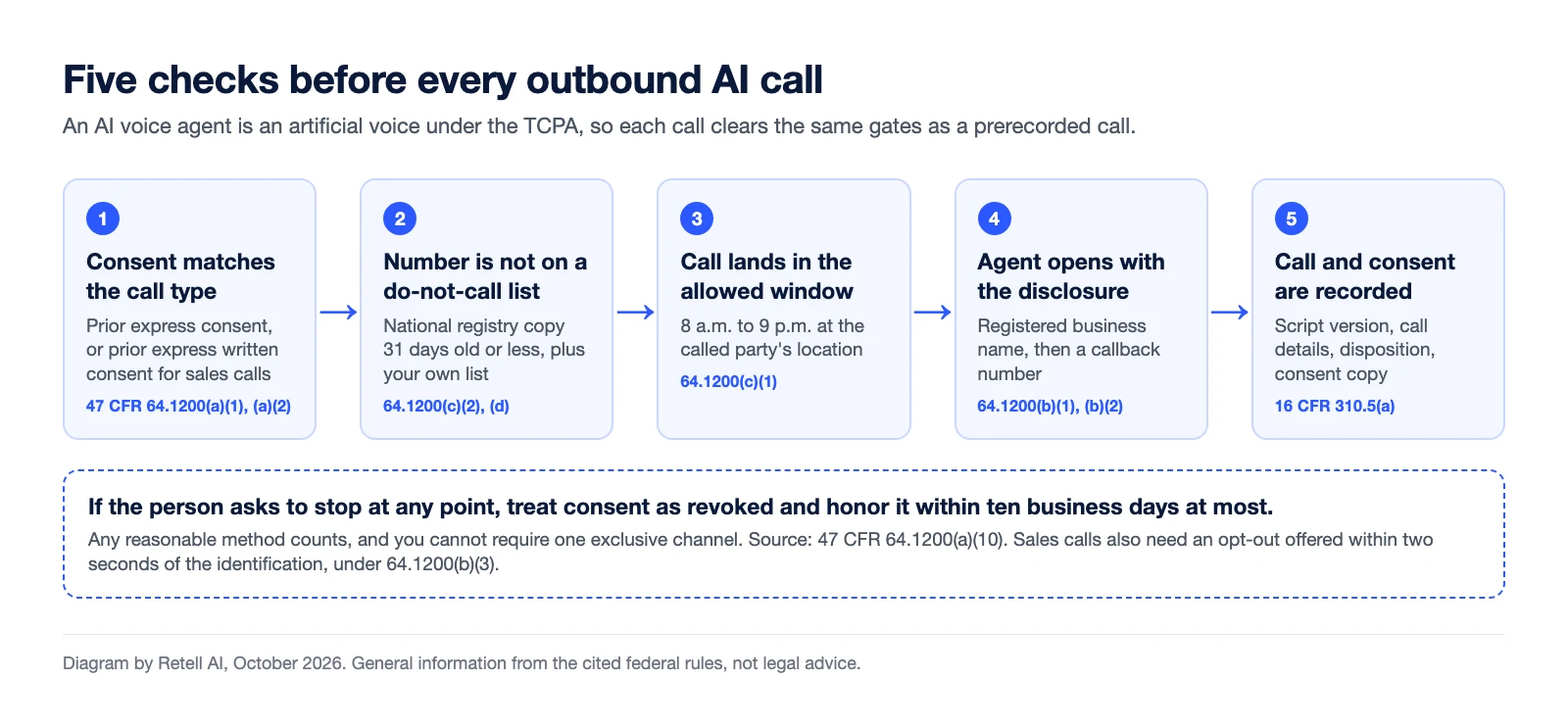
TCPA compliance for an AI voice agent means holding the right consent before the agent dials, having the agent identify your business and offer a way to opt out, calling only during permitted hours, honoring stop requests, and keeping records that prove each step. The reason is that the Federal Communications Commission (FCC) has said it treats AI-generated voices as "artificial" voices under the Telephone Consumer Protection Act (TCPA), so an AI call carries the same obligations as a prerecorded robocall.
This guide summarizes the federal rules as of October 21, 2026 for teams running outbound programs on Athena or any other platform. It is general information, not legal advice. Rules change, courts disagree on some of them, and states add their own requirements, so have counsel review your consent language and call flows before launch.
Does the TCPA apply to AI voice agents?
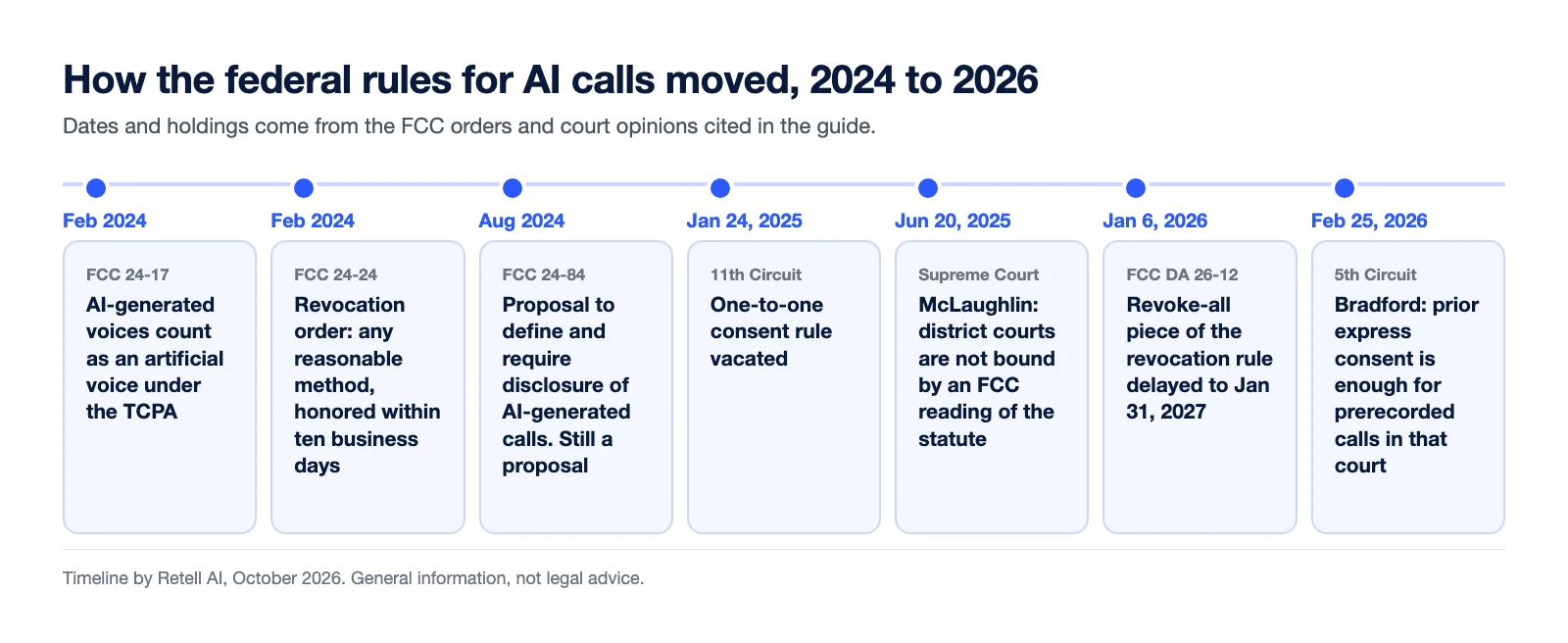
Yes. In a February 2024 Declaratory Ruling (FCC 24-17), the FCC confirmed that the TCPA's restrictions on "artificial or prerecorded voice" calls "encompass current AI technologies that generate human voices." The ruling adds that the TCPA "does not allow for any carve out of technologies that purport to provide the equivalent of a live agent." An agent that holds a real-time conversation is still an artificial voice for TCPA purposes, and calls that use it require the prior express consent of the called party unless an emergency purpose or exemption applies.
Four later developments matter for how you plan an outbound program.
- No final AI-call rule yet. In August 2024 the FCC proposed rules that would define AI-generated calls and require callers to disclose them (FCC 24-84, published in the Federal Register on September 10, 2024). As of October 21, 2026, a search of the Federal Register finds no final rule in that docket. The identification rules that already apply to artificial-voice calls are the working requirement.
- Courts are not bound by the FCC's reading. In June 2025 the Supreme Court held in McLaughlin Chiropractic v. McKesson that district courts are not bound by an agency's interpretation of a statute in enforcement proceedings. The 2024 ruling still shows how the FCC reads the law, but a court can reach its own reading.
- The Fifth Circuit relaxed the written-consent rule in its own territory. On February 25, 2026, in Bradford v. Sovereign Pest Control of TX, the Fifth Circuit held that the TCPA "requires no more" than prior express consent for any type of prerecorded call, and affirmed summary judgment for a company that called a customer who had given his number on a service agreement. The Fifth Circuit covers Texas, Louisiana and Mississippi. The FCC's rule text still requires prior express written consent for telemarketing calls, other circuits have not adopted the holding, and state laws are unaffected.
- The revoke-all piece is delayed. The part of the revocation rule that treats one stop request as covering all future calls on unrelated topics is waived until January 31, 2027 (FCC order DA 26-12, January 6, 2026). The rest of the revocation rule is in force. More on this below.
The safe plan is to treat every AI call as an artificial-voice call, keep written consent for any call that sells, and have counsel confirm how courts in the states and circuits you call into read these rulings.
Which consent does each outbound call need?
The consent you need depends on what the call says and what kind of line it reaches. Under the FCC's rules at 47 CFR 64.1200, a non-emergency artificial-voice call to a mobile number needs prior express consent, even when it is purely informational. The rules list narrow exceptions at 64.1200(a)(9) for certain calls that are free to the recipient, including some package delivery, financial institution and healthcare provider notifications, each with strict conditions on content, length and frequency, so check with counsel before relying on one. A call that advertises or sells needs prior express written consent. Calls to residential landlines follow their own limits.
| Call type | Consent needed | Rule |
|---|---|---|
| Any non-emergency artificial-voice call to a mobile number | Prior express consent (narrow exemptions apply) | 47 CFR 64.1200(a)(1), (a)(9) |
| Telemarketing call to a mobile number | Prior express written consent | 47 CFR 64.1200(a)(2) |
| Telemarketing call to a residential line | Prior express written consent | 47 CFR 64.1200(a)(3) |
| Non-sales commercial call to a residential line | None for up to 3 calls in 30 days, with opt-out honored | 47 CFR 64.1200(a)(3)(iii) |
| Health care message from a HIPAA covered entity or its business associate to a residential line | None for up to 1 call a day and 3 a week, with opt-out honored | 47 CFR 64.1200(a)(3)(v) |
Prior express written consent is an agreement in writing, bearing the signature of the person called (an electronic signature counts where it is valid under federal or state law), that clearly authorizes the seller to deliver telemarketing messages using an artificial or prerecorded voice and names the phone number. It must also tell the person that signing is not a condition of buying anything. If your lead forms were written before you moved outbound work to an AI agent, check that their wording covers artificial-voice calls.
You may have read about the FCC's 2023 "one-to-one" consent rule for lead generators. The Eleventh Circuit vacated it on January 24, 2025 (Insurance Marketing Coalition v. FCC), and it is not in the current rule text. Consent still has to authorize the specific seller that places the call, and the seller is the entity on whose behalf the call is made, even when a vendor or an AI platform dials it.
What must the agent say when the call connects?
Every artificial or prerecorded voice message must state, at the beginning, the identity of the business responsible for the call, using the name it is registered under with the state. During or after the message, it must give a callback number. For telemarketing calls, and for exempt calls to residential lines, the agent must also offer an automated voice or key-press opt-out within two seconds of that identification, with brief instructions. A voicemail left on those calls must include a toll-free number that connects to the opt-out. The FCC's 2024 ruling points to these same rules, noting that they apply "to any AI technology that initiates any outbound telephone call using an artificial or prerecorded voice."
No federal rule yet requires the agent to say the words "this is an AI." The identity and callback disclosures above are required today, and the FCC's 2024 proposal would add an AI disclosure if it is adopted. Adding a plain statement that the caller is an automated assistant is a low-cost way to match where the proposal points. Check state requirements before you finalize the wording.
Sales calls covered by the FTC's Telemarketing Sales Rule also require a prompt disclosure of the seller's identity, that the purpose of the call is to sell, and the nature of the goods or services. The same rule requires the caller ID number, and the name where the carrier supports it, to be transmitted on telemarketing calls.
In Athena, put the opening disclosure in the agent's Begin Message so it plays before the person speaks. In a conversation flow agent, use a first node with Skip Response and Block Interruptions turned on, as described in the docs on opening disclaimers callers can't talk over. Then turn on Do-not-contact Handling under Security & fallback settings. When someone asks not to be called again, the agent asks once whether to stop calling that number, and if the person confirms it ends the call and marks the contact as do-not-call. The feature works on Athena LLM and conversation flow agents, not custom LLM agents.
Two points need your own review. Athena's documentation describes a spoken request, not a key-press opt-out, so for sales calls ask counsel whether your setup meets the automated opt-out mechanism in 64.1200(b)(3), and write the opt-out instructions into the opening line yourself. And because a revocation made in any reasonable manner counts, have counsel review how the one confirmation question sounds in your call flow.
If your agent can reach voicemail, plan the voicemail script separately: it needs the identification, a callback number and, on sales calls, the toll-free opt-out line. The guide to answering machine detection covers how to tell a voicemail from a live answer before the agent speaks.
When can the agent call, and which numbers are off-limits?
Telemarketing calls must land between 8 a.m. and 9 p.m. where the person is. The window follows the called party's local time, not yours. Split national lists by time zone before you schedule a batch.
Telephone solicitations to residential subscribers are allowed only between 8 a.m. and 9 p.m. in the called party's local time (47 CFR 64.1200(c)(1)). The Telemarketing Sales Rule sets the same window for telemarketing calls to a person's residence, unless the person has consented to calls outside it.
Numbers on the National Do Not Call Registry are off-limits for telephone solicitations unless the person has given signed, written permission to be called by that seller. The FCC's safe harbor expects callers to use a version of the registry obtained no more than 31 days before the call. You also need your own company-specific list: record each do-not-call request when it is made, honor it within 10 business days, and keep it for five years.
Consent can be revoked "by using any reasonable method." The rule treats some methods as reasonable on their face, including an opt-out made through an automated voice or key-press mechanism on a call, a reply to a text using "stop," "quit," "end," "revoke," "opt out," "cancel" or "unsubscribe," or a website or phone number you designate for opt-outs. Revocations must be honored within a reasonable time that does not exceed ten business days, and you cannot designate an exclusive channel for them. A revocation sent by another route, such as a voicemail or email to a number or address meant to reach you, creates a rebuttable presumption that consent was revoked.
On scope, the FCC's 2024 revocation order says a stop request should end all robocalls and robotexts from that caller. The piece of the rule that would force a request made about one type of message to cover unrelated future calls is waived until January 31, 2027. Until then, the practical, lower-risk design is to treat any stop request as covering every outbound program from your company, and to write that into your call flow and your list-management process.
High-volume programs such as AI auto dialer campaigns need these checks wired into every path that places calls. In Athena, the do-not-call flag is checked by the Create Phone Call API when you pass honor_internal_dnc set to true, by the dashboard's Honor DNC switch (on by default), and by campaigns with internal DNC turned on. Batch calls do not check it, so scrub batch lists before upload. The batch call setup lets you define time windows, and the documentation does not say whether a window follows each recipient's time zone, so split lists by time zone yourself to keep every call inside the permitted hours. This internal list is separate from the National Do Not Call Registry, which you still need to scrub.
Several of the call types that end in a booked meeting or a callback, such as speed to lead and database reactivation, run on exactly the lists these checks apply to, so build the checks into the list before the first dial.
States add their own layer. Florida's Telephone Solicitation Act, for example, requires prior express written consent for sales calls that use automated dialing or a recorded message (Fla. Stat. 501.059(8)(a)), and lets consumers recover actual damages or $500 per violation, up to three times that amount if the violation was willful or knowing (501.059(10)). Check the rules in every state you call into.
How do the TCPA rules map to Athena settings?
Athena gives you controls for four of the obligations above. Consent, list scrubbing, time zones and the legal wording stay your responsibility, and the table marks where the documentation stops.
| Obligation | Athena control | What stays with you |
|---|---|---|
| Identify the business at the start of the call | Begin Message, or a first conversation flow node with Skip Response and Block Interruptions on | Writing the registered business name, callback number and opt-out instructions |
| Honor a stop request | Do-not-contact Handling confirms the request once, ends the call and sets the contact's do_not_call flag | A key-press opt-out is not documented, and the wording needs counsel's review |
| Skip numbers on your internal list | honor_internal_dnc on Create Phone Call, the Honor DNC switch, and internal DNC on campaigns | Batch calls and inbound calls do not check the flag, so scrub batch lists first |
| Keep records | Call data kept indefinitely by default, with per-agent retention from 1 day to 2 years, and user_requested_dnc as the disconnection reason for a stop request | Consent copies, agent version history and any export your retention period requires |
What records should you keep?
The Telemarketing Sales Rule requires sellers and telemarketers to keep telemarketing records for five years. A complete consent record includes the person's name and number, a copy of the consent request in the format it was presented, the purpose, a copy of the consent, and the date it was given. A record of each telemarketing call includes the calling and called numbers, the date, time and duration, the script or prerecorded message used, and the disposition, including the number a call was transferred to.
For an AI agent, the script is the prompt or flow version that ran the call, so tie agent versions to call records. Check your retention settings as well. Athena keeps call data indefinitely by default, and per-agent data retention periods range from 1 day to 2 years. If a retention period is shorter than your record-keeping obligation, export transcripts and recordings through webhooks before they are deleted. Opt-outs leave a trail too: when a call ends on a do-not-call request, Athena records the disconnection reason as user_requested_dnc, which you can export alongside your consent records.
What does a TCPA violation cost?
The TCPA lets a person sue for actual losses or $500 per violation, whichever is greater. A court can raise the award to three times that amount if it finds the violation was willful or knowing. Damages are counted per violation, and one campaign can place thousands of calls, so exposure grows with call volume. The FCC can also assess forfeitures on its own.
TCPA statutory damages: Exposure = violations × $500 (up to × 3 if willful or knowing)
2,000 calls without valid consent × $500 = $1,000,000 If a court finds the violations willful or knowing, up to 3 × $1,000,000 = $3,000,000
Damages are counted per violation, so call volume drives exposure.
The seller is the entity on whose behalf a call is made (47 CFR 64.1200(f)(10)), and for do-not-call requests recorded by another party, the rules hold the entity on whose behalf the call is made liable for failures to honor them (64.1200(d)(3)). Keep the consent and opt-out trail on your side of the contract with any dialing vendor.
What should you check before the first outbound call?
Use this list as a launch gate for any outbound agent that reaches US numbers.
- Consent on file matches the call type: prior express consent, or prior express written consent for sales calls.
- Written consent names the phone number, covers artificial-voice calls and says signing is not a condition of purchase.
- List scrubbed against the National Do Not Call Registry using a version no more than 31 days old.
- List scrubbed against your internal do-not-call list, including every batch upload.
- Opening line states the registered business name and a callback number.
- Opt-out offered with brief instructions, Do-not-contact Handling turned on, and counsel has reviewed the opt-out wording for sales calls.
- Voicemail script includes the identification, a callback number and, on sales calls, a toll-free opt-out line.
- Any stop request, by any reasonable method, is honored within ten business days and applied across every outbound program from your company.
- Calling window set to 8 a.m. to 9 p.m. in each recipient's time zone.
- Consent records, agent versions and call records kept for five years.
For the full launch list, including recording and AI disclosures, use the call consent and disclosure checklist. For a longer look at consent, litigation and vendor evaluation, read the TCPA compliance playbook for voice AI outbound. If you also call outside the US, the guide to calling laws by country covers Canada, the UK, the EU and other markets. Healthcare teams should read the HIPAA guide for AI phone agents, which covers the TCPA's health care message exemptions.
These rules apply to AI telemarketing, to AI voice agents for debt collection, and to every list you send through batch calling.
Consent records, disclosures and opt-out handling are easiest to prove when you have tested them on real calls before scaling. Talk to Athena about a pilot on your own outbound program.
Sources: 47 CFR 64.1200 and 16 CFR 310.4 and 310.5 (eCFR, October 2026); FCC 24-17, 24-24 and 24-84; FCC DA 26-12; 47 U.S.C. 227(b)(3); Fla. Stat. 501.059; Bradford v. Sovereign Pest Control of TX, No. 24-20379 (5th Cir. Feb. 25, 2026). Last reviewed October 21, 2026.